Page 2 of 3 FirstFirst 123 LastLast
Results 36 to 70 of 71

Thread: To be, or not to be a Harlan's

  1. #36
    Join Date
    Dec 2006
    Location
    Fort Worth, Texas
    Posts
    2,213

    Default

    Quote Originally Posted by OATS View Post
    I knew I shouldn't have hit the send button. Sorry Conor for sparking this off in your thread. Good move relocating it to a new one.

    Birders, naturalists, and ornithologists have been unsuccessfully debating this very topic for 150 years so there is no reason for us to agree on it either. This topic has been near and dear to me for some time since I have spent my whole life in the primary breeding region of Harlans and where the large majority of our redtails are Harlans phase. Yep I said phase. When one examines the scientific definition of a species or subspecies there is no biological justification for Harlan's hawks to be considered a separate subspecies let alone a separate species which they were considered for a long time. Many differing opinions amongst the experts out there. For every paper supporting a subspecies designation there is a study contradicting it. I, for one have seen hundreds if not thousands of Harlans, handled more than I can count, and have hunted them for many seasons (even have one in the mews as we speak). Many falconers in Alaska currently have Harlans and western phase RTs they hunt with. Around here, anybody who has hunted RTs for any amount of time and has experience with both phases can tell you that they are absolutely just redtails of a different hue and no two Harlans are colored the same. Every year we find a new nest or two where one of the parents is a traditional western phase and one is a Harlans. What does that make the offspring? Certainly not a different subspecies? Just like a litter of rabbits, dogs, etc. may have different color offspring, birds with diverse visual characteristics like redtails do the same.

    I don't want this thread to turn into a debate with people's personalities clashing over the inability to agree so let's be nice. I'm not big on arguing over something that really doesn't matter so we may have to agree to disagree. A redtail is a redtail. They are great falconry birds no matter what color they are.
    Eric, if you go back and reread my posts, I have basically said the same things you just said. I do not believe that every color morph (or phase as you call it) is a separate subspecies. If there are true RT subspecies, it is only a few. I also said that the Harlan's have a variety of tail colors, including rufous. The only thing we do disagree on is which phase Wendy is.
    Brandi

  2. #37
    Join Date
    Dec 2006
    Location
    Fort Worth, Texas
    Posts
    2,213

    Default

    Quote Originally Posted by rri32701 View Post
    Anyone know how to tell the other sub-species apart,Calurus,Borealis and Umbrinus?
    There is not really a specific look that separates them apart as there is a great color variation among RTs. Hence the reason I am in the taxonomic group that does not recognize them as subspecies. But those 3 RTs are defined by where they breed.

    Buteo jamaicensis borealis --- eastern red-tailed hawk
    Buteo jamaicensis calurus --- western red-tailed hawk
    Buteo jamaicensis umbrinus --- Florida red-tailed hawk
    Brandi

  3. #38
    Join Date
    Mar 2007
    Location
    Oklahoma
    Posts
    2,430

    Default

    Here are the pics of my friends RT. Cash has only dropped one tail feather so far and he says it's red with a black band and spotted.


    I will post a picture of him when he's done with the molt.

    And I can't leave this out

    Kim Mauldin

    "Believe"
    Marian & Bob Bailey

  4. #39
    Join Date
    Jul 2008
    Location
    Elko, Nevada
    Posts
    1,723

    Default

    Nope. Peregrine is a peregrine. A gyr is a gyr. A coopie a coopie a Red shoulder is a red shoulder. A ferruge is a ferruge. My Nevada ferruges are just the same as the S. Dakota ferruges. But then, I like to keep it simple. Put em in a box if healthy breeding babies pop out 9 months later, bingo! The same thing. Regardless of distance separation, migration and so on. My opinion.
    tony

  5. #40
    Join Date
    Nov 2007
    Location
    Colorado
    Posts
    701

    Default

    Quote Originally Posted by tony123abc View Post
    Nope. Peregrine is a peregrine. A gyr is a gyr. A coopie a coopie a Red shoulder is a red shoulder. A ferruge is a ferruge. My Nevada ferruges are just the same as the S. Dakota ferruges. But then, I like to keep it simple. Put em in a box if healthy breeding babies pop out 9 months later, bingo! The same thing. Regardless of distance separation, migration and so on. My opinion.
    I understand your thought on this, but many subspecies aren't just labeled that simply because of separation/migration. Many of these subspecies have very obvious morphological differences, for instance, a Harlans redtail has shorter wings than other subspecies of redtail...
    JenniB
    We promised the world we'd tame it, what were we hoping for?

  6. #41
    Join Date
    Jul 2008
    Location
    Elko, Nevada
    Posts
    1,723

    Default

    Spent a bazillion hours in the lab in college looking at stuff. Spent so much time looking at morph stuff under a microscope IDing critters and so on my eyes still hurt, and that was over 20 years ago. Of course I may just be getting old too. IMO, If you have a 100% count on all morphological differences in a given species, then make it a species. If it aint 100% it is a variation.

    http://www.thefreedictionary.com/subspecies

    I know more is needed in the definition link, but like I said, I keep it simple. I like finality.
    tony

  7. #42
    Join Date
    Nov 2007
    Location
    Colorado
    Posts
    701

    Default

    We'll just have to agree to disagree.
    JenniB
    We promised the world we'd tame it, what were we hoping for?

  8. #43
    Join Date
    Dec 2006
    Location
    Greensboro, NC
    Posts
    10,455

    Default

    Quote Originally Posted by Eagle Owl View Post
    They are comparing belly bands to the Krider's, not all RTs. Please don't twist words to suit your needs. And for the rest of your thinking...I guess no one should listen to anything Beebe and Webster have said, or McDermott, or Nick Fox, etc., because according to you, writing a book does not mean anything. Wheeler and Clark have both studied raptors for over 50 years. Clark worked for the NWF as the Director at the Raptor Information Center, has done extensive research on Harlan's hawks, Harris's hawks and white-tailed hawks. He has written numerous scientific papers and is well respected in the ornithological field. No offense, Fred, but I am going to listen to the opinion of someone that has spent almost their entire life studying these birds over someone who has flown a few RTs.
    So Brandi, with your reasoning, if Wheeler and Clark told you a golden eagle was a red-tail and posted a picture of it, would you believe them? Come on, don't get your panties all twisted in a wad here. Anytime someone disagrees with you, you take it personally. I just don't think that particular bird in that picture is a Harlan's, PERIOD! I am not twisting anybody's words around, just stating what I believe. And quite frankly, I really don't give a crap if you believe what I think or not, that isn't my point on posting. I just posted I don't think that is a Harlan's and unless you can provide better pictures that shows more proof, then as far as I am concerned it is just a light morph red-tail!

    Oh yeah, you need to re-read what you posted! They are not comparing the belly bands to just Kriders. They are describing a Harlan's in that paragraph and say The belly band is light or moderate (lacking in "Krider's" Red-tailed Hawks) and the wings have dark patagial marks, unlike Krider's. So they are saying the belly band is light or moderate and then say it is lacking in a Kriders, not saying it is light or moderate in comparison to a Kriders. And again, I will say, trying to compare belly bands on red-tails is about the worst way to determine a type of red-tail, they all vary so differently.

    It is a light morph red-tail, period!
    Fred
    "Adopt the pace of nature: her secret is patience." ~Ralph Waldo Emerson

  9. #44
    Join Date
    Jul 2008
    Location
    Elko, Nevada
    Posts
    1,723

    Default

    I am okay with that. I am one of them guys that are just set in his ways. Not always a good thing either.
    tony

  10. #45
    Join Date
    Nov 2007
    Location
    New Mexico
    Posts
    3,793

    Default

    Quote Originally Posted by FredFogg View Post
    I see nothing in those pictures that would make me identify that bird as a light phase Harlan's hawk! Sorry, just don't see it! Looks like a typical light phase red-tail.
    I'm with Fred on this one. I'd have to see that one molted to determine it to be an oddball Harlan's. It looks like a pretty standard immature RT to me. Not even a Krider's phase...just a little bit lighter phase common everyday run of the mill nothing special RT.
    Pete J
    It's all just too Zen for me.

  11. #46
    Join Date
    Nov 2007
    Location
    New Mexico
    Posts
    3,793

    Default

    Quote Originally Posted by kimmerar View Post
    Here are the pics of my friends RT. Cash has only dropped one tail feather so far and he says it's red with a black band and spotted.


    That's a good looking Buteo right there! If you're gonna have one, you might as well have on that looks as good as that one. It'll be interesting to see what it looks like after it molts.
    Pete J
    It's all just too Zen for me.

  12. #47
    Join Date
    Mar 2007
    Location
    Oklahoma
    Posts
    2,430

    Default

    Quote Originally Posted by PeteJ View Post
    That's a good looking Buteo right there! If you're gonna have one, you might as well have on that looks as good as that one. It'll be interesting to see what it looks like after it molts.
    Yes Pete - I agree. Murphy is hanging out with my friend this year. You know - just can't wait to see the new feathers I will update when I get a molted picture. It's going real slow. Even body feathers.
    Kim Mauldin

    "Believe"
    Marian & Bob Bailey

  13. #48
    Join Date
    Mar 2010
    Location
    Arizona
    Posts
    1,806

    Default

    Brandi, et.al.,

    True the ornithologists speak of 14 subspecies of RT's, but here is the catch, in order for them to be a subspecies they have to be a genetically distinct geographical subunit of the species; and, of course, none of them are, not even the Harlan's. Genetically, all the RT subspecies (races) are the same. It is my understanding that ornithologists use these "subspecies" as a matter of convenience more than anything else. So, what does all of this mean? Well, IMO, it means that these different "subspecies" are simply different colorations of the same animal.

    Bill Boni
    Norman, OK

  14. #49
    Join Date
    Oct 2009
    Location
    Alaska
    Posts
    452

    Default

    I couldn't agree more Bill. Jenni, not to be argumentative, IMO no way Harlans have a shorter wing chord or overall shorter wings for the body size. We may have to agree to disagree =)
    Eric Fontaine
    Southcentral Alaska

  15. #50
    Join Date
    Jul 2008
    Location
    Elko, Nevada
    Posts
    1,723

    Default

    I agree, Borneo is too hot and muggy. The darn Papuans will kill me and aint no roads in the Amazon. And them dang bugs are just plain icky! How will I ever get to name a critter, I got it, I will create some. Biggiest birsus westsidiest
    tony

  16. #51
    Join Date
    Jul 2008
    Location
    Elko, Nevada
    Posts
    1,723

    Default

    Oops. Bad grammer. Insert a period for the 1st.comma. And add a comma to correct the run on. Add a d in birdsus. Kill the comma at the end of critter & add a ? Sorry but Mr. Bill, I just can't follow you without trying to clean up the rightin a bit.
    tony

  17. #52
    Join Date
    Jun 2010
    Location
    Columbus, Ohio
    Posts
    84

    Default

    How about another "A" in grammar while you are at it! HEHEHE
    Trevor

  18. #53
    Join Date
    Dec 2006
    Location
    Fort Worth, Texas
    Posts
    2,213

    Default

    Quote Originally Posted by MrBill View Post
    Brandi, et.al.,

    True the ornithologists speak of 14 subspecies of RT's, but here is the catch, in order for them to be a subspecies they have to be a genetically distinct geographical subunit of the species; and, of course, none of them are, not even the Harlan's. Genetically, all the RT subspecies (races) are the same. It is my understanding that ornithologists use these "subspecies" as a matter of convenience more than anything else. So, what does all of this mean? Well, IMO, it means that these different "subspecies" are simply different colorations of the same animal.

    Bill Boni
    Norman, OK
    Bill, I completely agree.
    Brandi

  19. #54
    Join Date
    Jul 2008
    Location
    Elko, Nevada
    Posts
    1,723

    Default

    Gosh, I so suk at righting.
    tony

  20. #55
    Join Date
    Mar 2010
    Location
    Arizona
    Posts
    1,806

    Default

    Don't give up, Tony. You will get better at writing. But, understand, according to Dave Hampton, good writing denotes a good falconer, so keep at it :-)

    Bill Boni
    Norman, OK

  21. #56
    Join Date
    Jul 2008
    Location
    Elko, Nevada
    Posts
    1,723

    Default

    Bill, I will try. Graammer? That don't look right.
    tony

  22. #57
    Join Date
    Sep 2009
    Location
    Orlando Fl.
    Posts
    908

    Default

    Has anybody read "the Redtailed Hawk the great unknown" It describes the different sub-species and the differences between them including some being much better hunters than others.
    Robert Miller

    Orlando, FL

  23. #58
    Join Date
    Oct 2009
    Location
    Alaska
    Posts
    452

    Default

    Quote Originally Posted by rri32701 View Post
    Has anybody read "the Redtailed Hawk the great unknown" It describes the different sub-species and the differences between them including some being much better hunters than others.
    Interesting Robert. Who wrote it and where can I get one? Out of curiousity, what was the author's opinion on the best hunting subspecies and what are his/her qualifications and criteria for determining it? Thanks.
    Eric Fontaine
    Southcentral Alaska

  24. #59
    Join Date
    Dec 2006
    Location
    Greensboro, NC
    Posts
    10,455

    Default

    Quote Originally Posted by OATS View Post
    Interesting Robert. Who wrote it and where can I get one? Out of curiousity, what was the author's opinion on the best hunting subspecies and what are his/her qualifications and criteria for determining it? Thanks.
    http://www.mikesfalconry.com/product.asp?specific=1226
    Fred
    "Adopt the pace of nature: her secret is patience." ~Ralph Waldo Emerson

  25. #60
    Join Date
    Nov 2007
    Location
    Eau Claire, WI
    Posts
    347

    Default

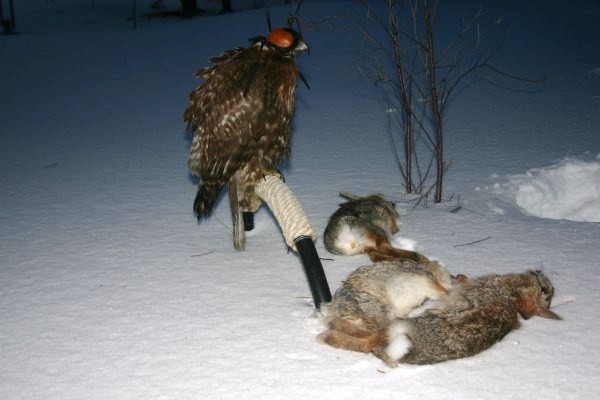
    Here's one of the best red-tailed (rufous morph) I have ever flown. He was released after the molt (I always released my rt's after the molt). Unless of course I wanted to keep it for another the season, but comes trapping season, I am itching to trap a new bird so I always ended up releasing them.

    Tripple:


    After a successful hunting:


    Molt completed (released):
    Tou Yang

  26. #61
    Join Date
    Sep 2009
    Location
    Orlando Fl.
    Posts
    908

    Default

    Quote Originally Posted by OATS View Post
    Interesting Robert. Who wrote it and where can I get one? Out of curiousity, what was the author's opinion on the best hunting subspecies and what are his/her qualifications and criteria for determining it? Thanks.
    Its written by Beatriz E.Candril .Its a 285 page book written to enlighten European Falconers about Redtails.It has a couple sections wriiten by american Falconers such as Jim Gwiazdzinski.
    I believe I got it from Mikes Falconry.It likens Borealis to being Accipter Like and a very good hunter and Calurus being slower and weaker but still being able to take rabbits and small hare but not Squirrels
    This book deals heavly with differences in subspecies and in my MHO
    has a lot of inaccuracies and contradicts itself from one chapter to another
    Robert Miller

    Orlando, FL

  27. #62
    Join Date
    May 2007
    Location
    Boise, ID
    Posts
    892

    Default

    I wouldn't describe the Borealis that I've seen as Accipiter like?

    This looks like a good description of the different subspecies (if you believe in them ).

    http://www.birdwatching-bliss.com/re...ubspecies.html
    Ryan - Boise, ID
    Every normal man must be tempted at times to spit on his hands, hoist the black flag, and begin to slit throats.

  28. #63
    Join Date
    Sep 2009
    Location
    Orlando Fl.
    Posts
    908

    Default

    Quote Originally Posted by Eragon View Post
    I wouldn't describe the Borealis that I've seen as Accipiter like?

    This looks like a good description of the different subspecies (if you believe in them ).

    http://www.birdwatching-bliss.com/re...ubspecies.html
    I wouldn't either I was just quoting from the book.
    That link just gave the ranges but nothing that would help where their ranges overlap
    Robert Miller

    Orlando, FL

  29. #64
    Join Date
    Feb 2008
    Location
    Archer Florida
    Posts
    2,631

    Default

    Very interesting thread.
    I'm curious about what Brandi quoted that "the wingtips of a Harlan's fall short of the tip of the tail" and Robert quoted "Borealis to being accipiter like."
    Having measurement and clear conformation differences would help out a lot.
    In my limited experience raptors, redtails especially vary greatly in their coloration. Raptors like the ferruginous have color phases that occur in the same nest, frequently. Parrots are much easier to identify LOL. Even their mutations are predictable and easy to identify. The first person to have a black, or even navy blue bluefront appear in a nestbox will make a mint. But these wildly varying redtails are to be found on every other power pole.
    My first RT was a fairly normal colored girl till she began to moult her coverts. Looking at pics now I see that she got very dark indeed. But though I read about them and wondered, she was no harlans.
    Cool thread.
    Meridith
    "I've spent the better part of the past year as a multi-dimensional wavelength of celestial intent."

  30. #65
    Join Date
    Nov 2009
    Location
    Plano Texas
    Posts
    34

    Default

    I haven't seen a lot of harlan's, but this is Katana, Kylee's bird. I believe she lives in Fort Worth, Texas. Sorry for the poor image quality, this was when my camera was broken and I was using a friend's.


    Beth Fortner
    Bells, Texas

  31. #66
    Join Date
    Jan 2010
    Location
    WARREN, MI
    Posts
    1,878

    Default

    i don't know much about rt sub species but i just want to say that the last picture posted is a very awesome looking bird! i love the color. the tail color and the dark color body just looks great!!!
    Rey

    Warren, Michigan

  32. #67
    Join Date
    Nov 2008
    Location
    Canada
    Posts
    424

    Default


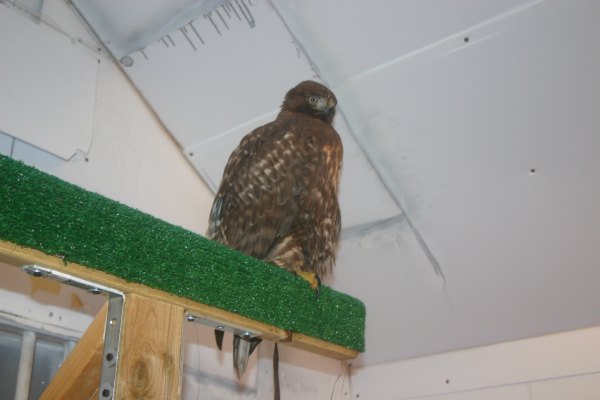
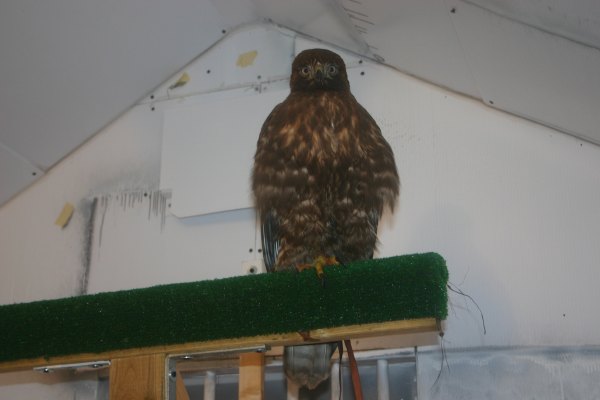
    Here are a few pictures of my Redtail, I trapped him July 21, 2009. Both pictures of the bird are before molting, the picture of the tail feather is of one that has just finished growing in after his molt (which is still going on). Not your typical Redtail tail feather... Any opinions?
    Greg

  33. #68
    Join Date
    Dec 2006
    Location
    Greensboro, NC
    Posts
    10,455

    Default

    Quote Originally Posted by canvibe View Post


    Here are a few pictures of my Redtail, I trapped him July 21, 2009. Both pictures of the bird are before molting, the picture of the tail feather is of one that has just finished growing in after his molt (which is still going on). Not your typical Redtail tail feather... Any opinions?
    I believe the tail color is due to the wrap on the perch!
    Fred
    "Adopt the pace of nature: her secret is patience." ~Ralph Waldo Emerson

  34. #69
    Join Date
    Nov 2008
    Location
    Canada
    Posts
    424

    Default

    That's crazy, but now that I look at the pattern they are both similar. I hope for your sake you were joking. Lol
    Greg

  35. #70
    Join Date
    Dec 2006
    Location
    Greensboro, NC
    Posts
    10,455

    Default

    Quote Originally Posted by canvibe View Post
    That's crazy, but now that I look at the pattern they are both similar. I hope for your sake you were joking. Lol
    Can't speak for others, but if you see and on my post, it means I am joking! LOL
    Fred
    "Adopt the pace of nature: her secret is patience." ~Ralph Waldo Emerson

Thread Information

Users Browsing this Thread

There are currently 1 users browsing this thread. (0 members and 1 guests)

Posting Permissions

  • You may not post new threads
  • You may not post replies
  • You may not post attachments
  • You may not edit your posts
  •